
Updated May 11, 2026 · Originally published April 28, 2026
🔑 Key Takeaways
- Optical absorbance is how it works: tCheck shines specific wavelengths of light through your infusion sample and measures how much is absorbed. The amount of absorbed light correlates directly with THC and CBD concentration.
- A simplification of HPLC chemistry: Commercial labs use HPLC ($35,000–$50,000 instruments). tCheck takes the optical-detection step from that process and makes it small, simple, and home-usable.
- Accurate enough for home dosing: Validated against HPLC standards within ±3-4 mg/mL for flower-based infusions. Calibrated specifically for cannabinoid detection in cooking oils, butters, and tinctures.
- Sample prep matters more than the device: Your reading is only as accurate as your sample. Homogenization, decarboxylation completeness, and clean filtering have a bigger effect than any device variability.
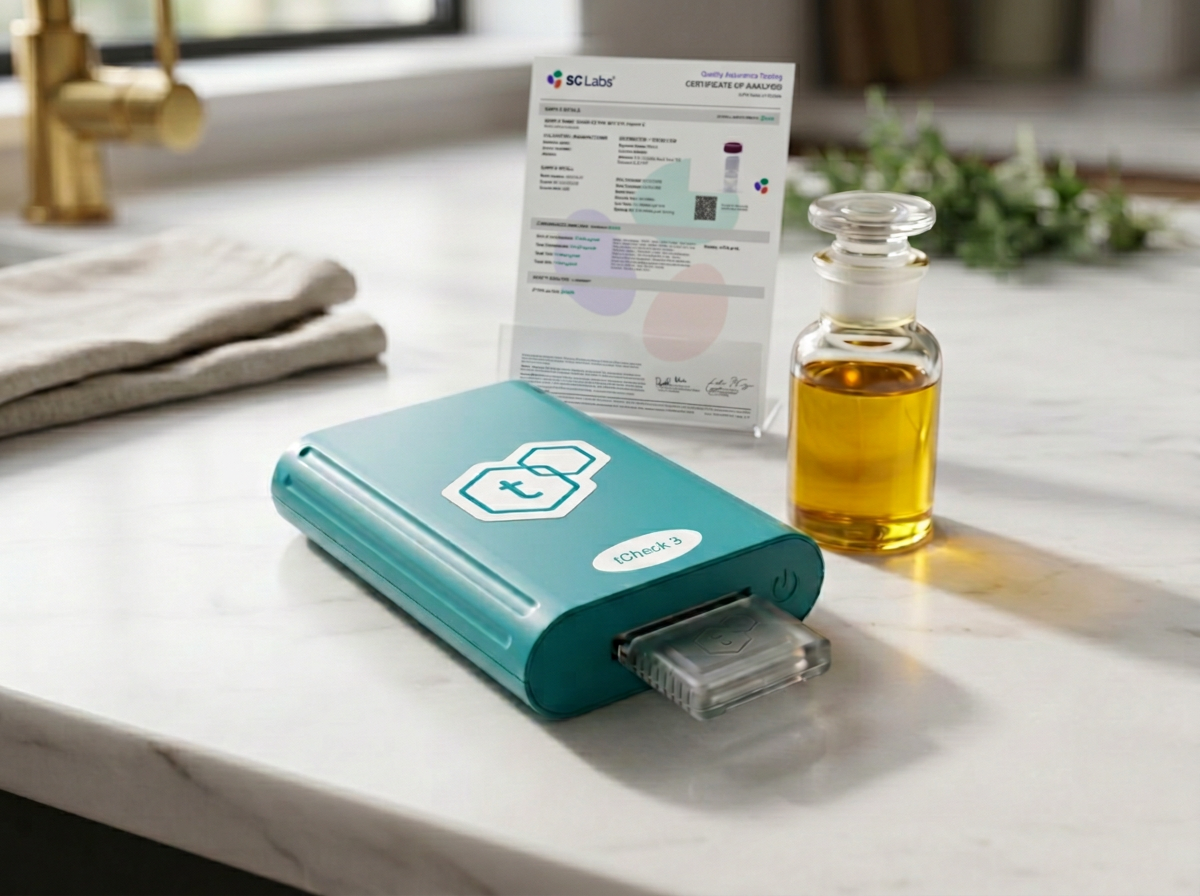
- Test before you dose: the tCheck Potency Tester measures THC and CBD potency in cooking infusions in about 2 minutes — built so you can dial in dosing without sending samples to a lab.
How Does an At-Home THC Tester Actually Work?
If you've ever held the tCheck device and wondered, "Wait -- how does this little thing actually know how potent my infusion is?" -- you're asking exactly the right question. The short answer: light. Specifically, UV absorbance spectrophotometry. The longer answer is worth understanding, because it's what separates a real measurement tool from a guess.
This article breaks down the optical method tCheck uses to measure THC and CBD potency -- in plain language, no chemistry degree required. By the end, you'll understand why the method works, why it's accurate enough for the best THC potency tester for home use, and where its limits are (yes, we'll be honest about those too).
Light as a Measuring Tool
Here's the core idea: different molecules absorb different wavelengths of light. THC, CBD, and other cannabinoids absorb ultraviolet light in a very specific, predictable way. When UV light passes through a sample that contains cannabinoids, some of that light gets absorbed -- and the amount absorbed is directly proportional to how much THC or CBD is present.
Think of instant coffee. The more crystals you dissolve, the darker the liquid gets -- and the less light passes through it. Measure how much light makes it through, and you can work backward to figure out exactly how much coffee is in the cup. tCheck uses the same logic, with one important difference: cannabinoids are colorless and invisible to the naked eye, so instead of visible light, the device uses UV light, which cannabinoids absorb very strongly.
 The result is a direct, physical measurement of concentration -- not an estimate, not a calculation based on assumed potency, but an actual reading of what's in your sample.
The Simplification That Makes tCheck Possible
A general-purpose laboratory spectrophotometer is designed to measure just about any compound in any liquid. That flexibility makes it powerful -- and expensive, complex, and completely impractical at home.
tCheck takes a different approach: it asks you one question before you test. What are you starting with?
That single piece of information changes everything. If you're starting with hemp, you're almost certainly measuring CBD -- hemp contains far more CBD than THC. If you're starting with cannabis flower or a THC-dominant infusion, you're measuring THC. Because you tell tCheck what you're working with upfront, the device doesn't need to identify unknown compounds from scratch. It already knows what it's looking for.
This prior knowledge allowed the engineering team to dramatically simplify both the electronics and the user interface -- stripping away roughly 90% of the complexity of a general-purpose instrument while keeping the measurement accuracy that matters for home dosing. The result is a device that fits in your hand, produces results in 2 minutes, and doesn't require a chemistry background to operate.

Inside the tCheck Device: What's Actually Happening
When you load a sample into the tCheck device, here's what happens in those 2 minutes:
- A UV light source illuminates the sample. The device emits UV light at the specific wavelength range where cannabinoids absorb most strongly.
- The sample absorbs some of that light. THC, CBD, and related cannabinoids each have a characteristic absorption fingerprint -- a wavelength range where they absorb more strongly than anything else in a properly prepared sample.
- A detector on the other side measures how much light made it through. The difference between the light that went in and the light that came out is the absorbance reading.
- The device applies a calibration curve to convert absorbance to concentration. tCheck's calibration was built using reference standards and validated against lab results. The math that converts a raw absorbance number into "X mg/mL of THC" is baked into the device's firmware.
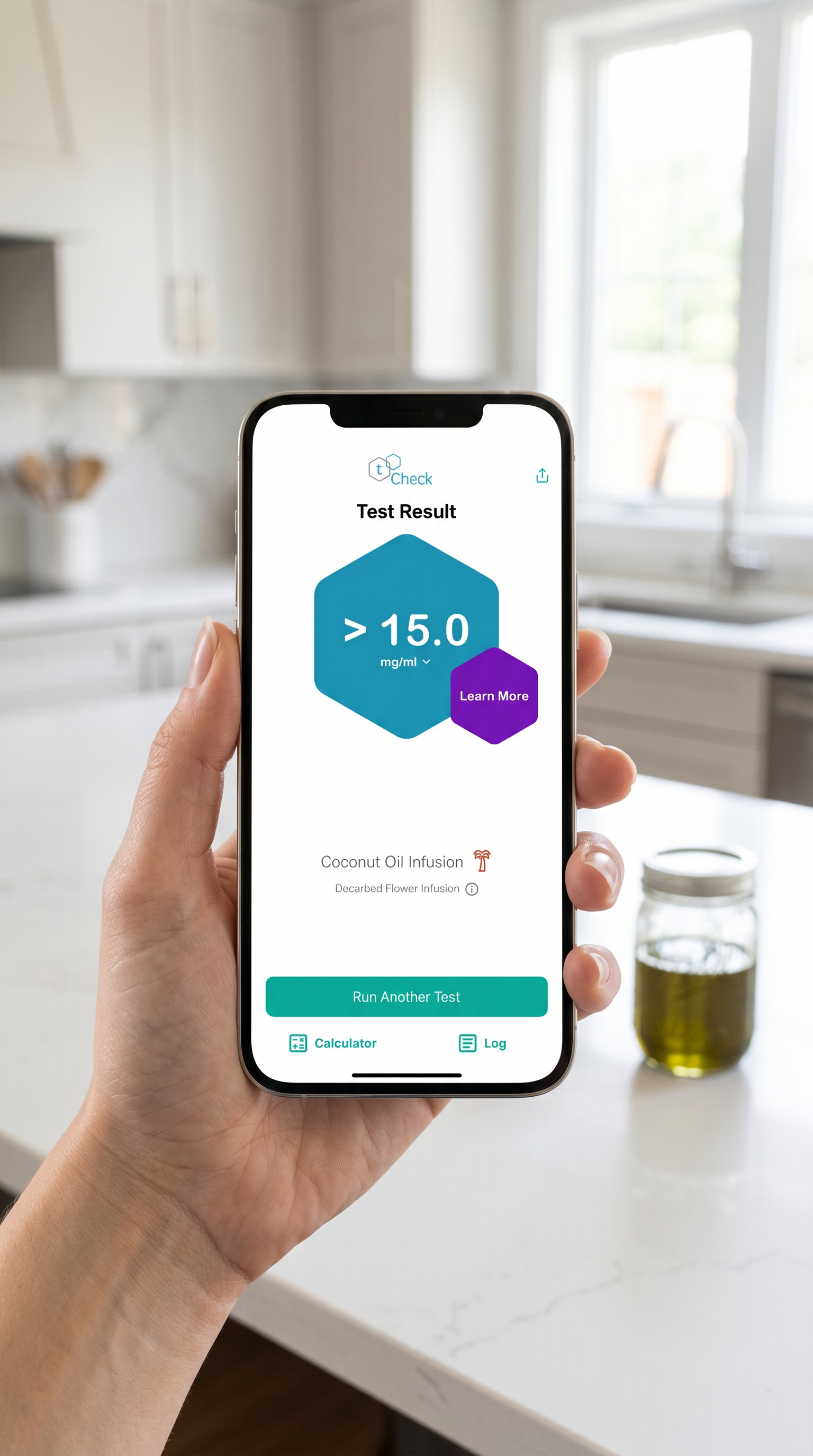
- Your result appears on the app in mg/mL or % potency. From there, you can plug the number into any dosing calculator to figure out exactly how many milligrams per serving your batch contains.
The whole process takes about 2 minutes per sample. There's no sending anything to a lab. No waiting days for results. Just load, test, read.

Why This Method Is Accurate Enough for Home Use
Accuracy is the first question most people ask -- and it's the right one to ask. The honest answer: tCheck is accurate enough to make real, meaningful dosing decisions at home, and it consistently outperforms the methods most home infusers rely on today (calculators, recipes, and guesswork).
Here's why the optical method holds up:
- The underlying physics is extremely reliable. UV absorbance is a direct physical measurement. There's no ambiguity in whether light was absorbed or not.
- Cannabinoids have a strong, distinct UV signature. THC and CBD absorb UV light at wavelengths that don't overlap significantly with common carrier oils (like MCT, olive, or coconut oil), which means the device is measuring the cannabinoids -- not the background.
- tCheck's calibration was validated against lab results. The conversion from absorbance to concentration was built using reference-grade standards, tested across hundreds of real-world samples.
That said, accuracy depends on one thing the device can't control: how well you prepare your sample.
The One Variable That Matters Most: Sample Preparation
The optical method is only as good as the sample you give it. A perfectly homogenized, correctly diluted, well-prepared sample will give you a highly accurate result. A poorly mixed, contaminated, or improperly diluted sample will give you a number that doesn't reflect reality -- regardless of how precise the optics are.
The most common preparation mistakes are:
- Not homogenizing the infused oil thoroughly before sampling (cannabinoids settle and separate)
- Using a dirty or worn syringe + filter that introduces residue from previous tests
- Testing an under-decarbed batch, where a significant portion of the THC is still in THCA form (which is measured differently)
- Introducing air bubbles into the sample chamber
These aren't reasons to distrust tCheck. They're reasons to treat sample prep as seriously as you treat the test itself. The device is doing its job; your job is to give it a clean, representative sample. For a solid foundation, understanding four easy decarboxylation methods sets you up for accurate testing from the start.
THCA vs. THC: Why the Numbers Can Look Different
Raw cannabis doesn't contain much active THC - it contains THCA (tetrahydrocannabinolic acid), the precursor. THCA converts to THC through heat in a process called decarboxylation. This matters because in infused oils, tCheck measures active THC, not THCA.
This is why a sample from an under-decarbed batch will read lower than expected -- the THC just isn't there yet, chemically speaking. It's not a measurement error. It's a real reflection of what's in your infusion.
Understanding what decarboxylation is and why it matters is the single most useful piece of background knowledge for any home infuser. If your numbers seem low, this is the first thing to check.
How tCheck Compares to a Commercial Lab
Commercial cannabis labs use HPLC (high-performance liquid chromatography), a more complex method that can separate and identify individual cannabinoids with very high precision. tCheck uses UV absorbance, which is the final detection part of an HPLC, after the separation process.
The practical difference: a lab test tells you the exact cannabinoid profile of a sample at a single point in time. tCheck tells you the THC and CBD concentration of your infusion right now, in your kitchen, in 2 minutes, at a tiny fraction of the cost of an HPLC.
Because the tCheck does not have the complex and expensive cannabinoid separation parts of an HPLC, it can only measure the dominant cannabinoid that you told it.
For home infusers, that trade-off is a clear win. You're not submitting products for regulatory certification. You're making sure your brownies have the right dose per serving, batch after batch. tCheck is purpose-built for exactly that use case.

The Bottom Line
tCheck works because the physics works and because the engineering team made a design choice that general-purpose lab instruments can't make: they let the user's starting material do half the work. UV absorbance spectrophotometry is a proven, reliable method, and knowing whether you're testing a hemp infusion or a THC-dominant oil means the device only needs to do one focused job, not a hundred general ones.
If you want to stop guessing and start knowing what's actually in your infusions, the tCheck THC potency tester is the only at-home tool built on this foundation. Results in 2 minutes. No lab required. No more mystery batches.
Ready to see what's actually in your infusion? Try the tCheck at-home potency analyzer -- and the next time you make a batch, you'll know exactly what you made.
❓ Frequently Asked Questions
Is the tCheck optical method as accurate as HPLC?
It's accurate enough for home dosing decisions but not lab-grade. Validated against HPLC, tCheck reads within about ±3-4 mg/mL on flower-based infusions — close enough to dial in your dosing, but a commercial lab is still the right tool for product certification or regulatory compliance.
Why does my tCheck reading not match a dispensary lab COA?
Three usual reasons: (1) you tested an infusion while the COA tested raw flower, (2) your sample preparation was different, or (3) THCA vs. THC accounting differs between methods. The reading itself is usually fine — what differs is what each instrument is measuring.
How long does a tCheck reading take?
About 2 minutes from putting your prepared sample on the tray to a final mg/mL reading. Most of that is sample prep — the actual optical measurement is a few seconds.
Does tCheck measure THCA or THC?
tCheck reads activated cannabinoids — primarily THC and CBD after decarboxylation. If your sample still has unactivated THCA in it, that contributes differently to the reading. This is why decarbing fully before testing is so important.
Ready to See It In Action?
Test your edibles, oils, and tinctures with the same optical method explained above — at home, in about 2 minutes.
Try the tCheck Potency Tester →

Written by
Peichen Chang
Founder & CEO, tCheck
Peichen spent most of his career designing ASICs (computer chips) for enterprise data storage. One day, a friend asked for help dosing her homemade edibles to control Parkinson’s symptoms, and tCheck was born. When he is not communing with AIs, he is cooking, traveling, or hiking.