Updated September 24, 2026 · Originally published September 22, 2026
If you are new to making infused edibles, you’ve probably heard many different ways to decarb. Flower is expensive and decarbing the first time can be a bit scary because you don’t want to mess up. Fortunately, there are easy ways to minimize that risk and maximize your returns.
A study from the University of Mississippi's National Center for Natural Products Research tracked decarboxylation minute by minute, and the takeaway for home cooks is simple:
The Quick Version
- Keep your oven at or below 230°F (110°C), and there's very little risk of over-decarbing. If you're unsure, leaving it in an extra 10–20 minutes is the safer bet.[1]
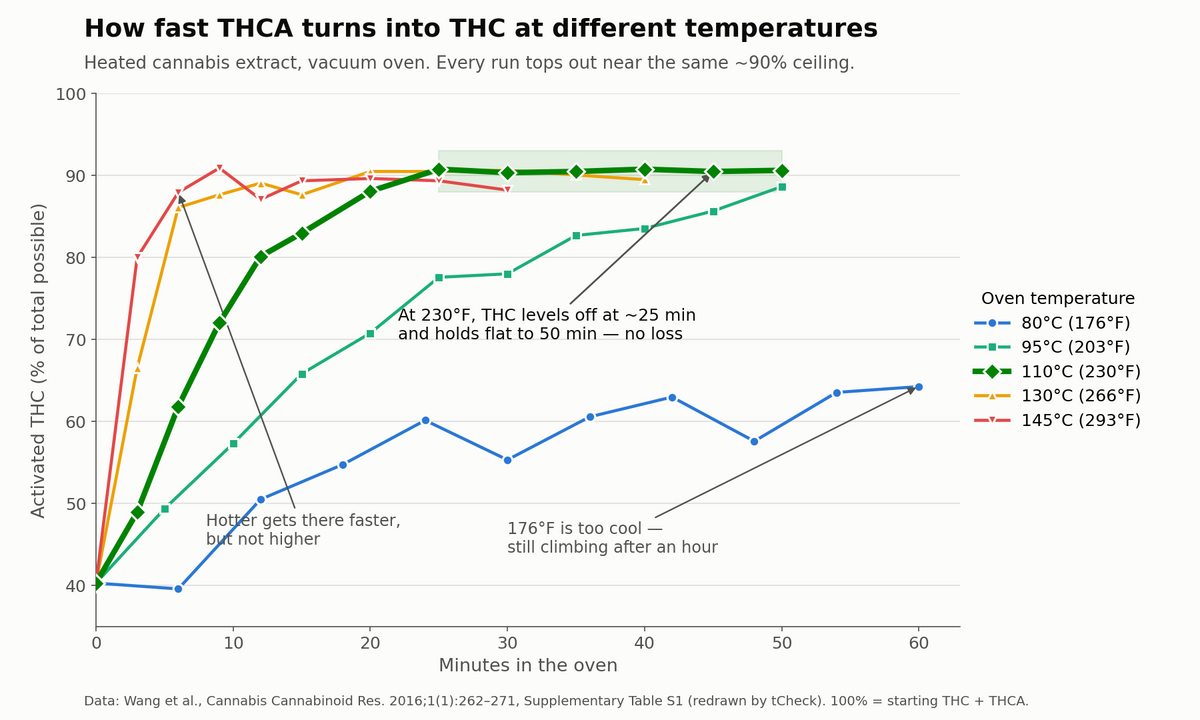
- Hotter is faster, but not higher. 266°F and 293°F finished in 6–9 minutes, but topped out at the same level as 230°F.
- Stopping too early is the bigger risk. Twenty extra minutes at 230°F did not hurt anything, while stopping early means you haven’t fully activated your flower.
- Bottom line: when in doubt, go longer, not hotter.
A Quick Refresher: What Decarbing Actually Does
Raw cannabis contains mostly THCA, the acidic precursor to THC. THCA isn't what most people are after in an edible, so it needs to be "activated" with heat. That heat knocks a small molecule (carbon dioxide) off the THCA, leaving THC behind. That step is decarboxylation, or decarb for short.
The Study
In 2016, Wang and colleagues published a decarboxylation study in Cannabis and Cannabinoid Research.[1] They heated cannabis extract at five temperatures (176°F, 203°F, 230°F, 266°F and 293°F, or 80°C to 145°C) and pulled samples every few minutes for up to an hour. For each sample, they measured how much THCA was left, how much THC had formed, and whether any CBN (a common breakdown product of THC) was showing up.
Finding #1: Hotter Is Faster, but Not Higher

Each line is a different oven temperature. A few things jump out:
- 176°F is too cool. After a full hour, THC is still climbing and a large share of the THCA hasn't converted. Low-and-slow can go too low.
- 203°F gets close but takes a long time. After 50 minutes it was still creeping upward.
- 230°F finishes in about 25–30 minutes, then flattens out. That thick green line is the one to watch.
- 266°F and 293°F finish in 6–9 minutes. Much faster, but they top out at the same level as 230°F.
Finding #2: At 230°F, the Extra Time Is Free

This chart zooms in on 230°F and follows each compound separately:
- Orange (THCA) turns into Blue (THC). After 30 minutes, nearly all of the THCA has been converted to THC
- Pink (CBN) stays low the whole time meaning that THC does not convert to CBN
- Purple (THC + THCA combined) dips slightly while the conversion is happening (a small loss the researchers measured during the conversion itself, separate from the carbon dioxide given off), then holds steady.
Now look at the shaded area. From 30 to 50 minutes, THC didn't budge. It measured about 90% at 30 minutes and was still about 90% at 50 minutes. Twenty extra minutes at 230°F does not hurt anything. On the other hand, stopping too early means that you haven’t fully activated your flower.
When in doubt, go longer, not hotter.
Why Your Kitchen Needs a Bigger Buffer Than the Lab Did
The study's 25–30 minute finish time is a best case, and it's worth being clear about why:
- They heated a thin film of extract, not flower. A thin residue in a small vial comes up to temperature almost instantly. Buds on a baking sheet take a while to heat through, especially if they're dense or a little moist.
- They used a vacuum oven. That removed oxygen and light, the two things that help turn THC into CBN. Your kitchen oven has both, which is one more reason not to push the temperature higher than you need.
- Home ovens aren't precise. Many ovens swing well above and below the set temperature as the element cycles on and off. A dial set to 230°F can briefly run hotter. (It's one of the 3 myths of decarboxylation we've busted.)
All three point the same way. Your flower will probably take longer than 30 minutes to fully activate, and staying at 230°F keeps you in the forgiving zone even when the oven overshoots a little.
Putting It Into Practice
- Set the oven to 230°F (110°C) and check it with an inexpensive oven thermometer. Don't trust the dial.
- Break flower into small pieces and spread it in a single layer on parchment so it heats evenly.
- Plan for 40–50 minutes. The study used a tiny amount of material which comes up to temperature quickly. Your flower material will take longer to reach decarboxylation temps.
- If you're not sure, add time, not heat. At 230°F, the data says extra minutes are cheap insurance.
For step-by-step oven, mason jar, foil and sous vide instructions, see our guide on how to decarb weed. No oven? Try our stovetop decarb method.
Don't Guess — Check
Every batch of flower is different, and every oven is different. The best way to know whether your decarb actually finished is to measure it. tCheck reads activated THC in your infused oil, butter or tincture, so you can compare batches, see whether a longer decarb made a difference in your setup, and dial in a routine that works in your kitchen.
Know Your Decarb Actually Worked
The tCheck Potency Tester measures THC or CBD in your infusions in about 2 minutes, so you can confirm your process instead of guessing.
Get the tCheck Potency Tester →References
- [1] Wang, M., Wang, Y.-H., Avula, B., Radwan, M. M., Wanas, A. S., van Antwerp, J., Parcher, J. F., ElSohly, M. A., & Khan, I. A. (2016). Decarboxylation study of acidic cannabinoids: A novel approach using ultra-high-performance supercritical fluid chromatography/photodiode array-mass spectrometry. Cannabis and Cannabinoid Research, 1(1), 262–271. DOI: 10.1089/can.2016.0020 · PMC5549281
This article summarizes published research for informational and educational purposes only. It is not medical advice, and it does not make any claims about the health effects of cannabis. Study conditions (heated cannabis extract in a laboratory vacuum oven) differ from home kitchens, and your results may vary. Always follow the laws in your area.

Written by
Peichen Chang
Founder & CEO, tCheck
Peichen spent most of his career designing ASICs (computer chips) for enterprise data storage. One day, a friend asked for help dosing her homemade edibles to control Parkinson’s symptoms, and tCheck was born. When he is not communing with AIs, he is cooking, traveling, or hiking.
📚 Related Reading
- How to Decarb Weed: 4 Easy Methods That Actually Work
- Decarboxylation Defined – The How, What and Why of Decarbing
- The 3 Myths of Decarboxylation: Busted!
- How to Decarboxylate Weed on the Stovetop
- Why Your Cannabis Infusions Lose Potency (and How to Slow It Down)
- Cannabis Infusions: A Beginner's Guide