
Updated May 15, 2026 · Originally published May 15, 2026

Yes, you can test cannabis flower at home — but it works differently than testing an infused oil or tincture, and it requires a bit more preparation. Testing cannabis flower at home means dissolving a carefully measured sample in reagent, filtering it, and then running it through your tCheck flower potency tester. The result tells you the potency of your flower before you ever heat it, grind it, or infuse it into anything.
That matters more than most home infusers realize. The potency of your source material is the single biggest variable in your final edible. Two batches made with identical recipes, identical equipment, and identical technique will come out completely different if the flower they started with varied in potency — and flower potency varies, sometimes dramatically, even within the same strain.
Knowing what you're starting with means you can predict what you'll end up with. This article walks through exactly how flower testing works, what equipment you need, and how to interpret your results.
🔑 Testing Cannabis Flower at Home: Key Takeaways
- What flower testing does: Measure THCA potency in raw cannabis before infusion — see exactly what you're starting with.
- Why it's different from oil testing: Cannabinoids are locked inside the plant material — reagent extracts them into a solution the device can read.
- What you need: A tCheck device plus the Flower Testing Expansion Kit for the reagent, syringes, and nano filters.
- Why test both: Flower potency is your ceiling; infusion testing is what you actually captured. Tracking both reveals your infusion efficiency.
- Get started: Pair the tCheck cannabis testing device with the expansion kit to test flower, concentrates, and infusions in one workflow.
🌿 Can You Really Test Flower at Home?
Yes — and the process gives you a confident starting point for every batch you infuse afterward. Testing cannabis flower at home means dissolving a carefully measured sample in reagent, filtering it, and then running the resulting solution through your tCheck device.
Until you know your flower's potency, every infusion downstream is a guess. Two batches made with identical recipes will land in very different places if the flower behind them varied. Flower testing eliminates that variable.
🧰 What You Need to Test Flower at Home
Testing infused oil with tCheck uses only the device and a standard syringe. Flower testing requires one additional piece: the Flower Testing Expansion Kit. This is what unlocks the ability to test non-infused cannabis material — dried flower, buds, trim, shake, and winterized concentrates.
The kit includes:
- Reagent solution (two 100 mL bottles, enough for 20 tests)
- Sample preparation syringes and nano filters
- Small sample containers for the dissolution process
- The tCheck device itself (purchased separately if you don't already own one)
If you already own the expansion kit and are running low on supplies, the Flower Testing Expansion Kit Refill Set restocks everything you need for up to 30 more tests at a fraction of the original kit cost.
🧬 Why Flower Testing Requires a Different Process
When you test an infused oil, the cannabinoids are already dissolved into the fat. They're evenly distributed (assuming good homogenization) and ready for tCheck to measure directly.
Flower is different. The cannabinoids are locked inside the plant material, bound to trichomes on the surface of the bud. To measure them, you first have to extract them into a liquid the device can read. That's what the reagent does — it's a solvent that pulls the cannabinoids out of the plant material and into solution, creating a testable liquid from what started as a solid.
This is also why flower testing measures THCA rather than active THC. Raw, non-decarbed flower hasn't been heated yet, so the THC is still in its acidic precursor form. The tCheck app accounts for this and reports your result in a way that helps you understand what you're working with. If you're new to the chemistry, our guide to decarboxylation explains the THCA-to-THC conversion in plain language.
The underlying principle is the same one used in professional analytical chemistry: dissolve the sample in a solvent, filter it, and measure the cannabinoid concentration optically. tCheck brings that same scientific approach home — without the lab equipment, the shipping, or the week-long wait for results.
🔬 Step-by-Step: How to Test Cannabis Flower with tCheck
- Grind your flower finely and evenly. A consistent grind increases the surface area exposed to the reagent, which improves extraction efficiency and result accuracy. Cannabinoids are not evenly distributed in all parts of the plant, so for the most accurate reading, grind and mix (homogenize) thoroughly.
- Weigh your sample precisely. Accurate results depend on accurate measurement. Use a scale that is accurate to at least 0.001 grams.
- Add the reagent to your sample container. Measure the reagent carefully using the provided syringe — the app tells you the exact amount. The reagent is the solvent that extracts the cannabinoids from the plant material.
- Mix thoroughly. Shake or stir the mixture well to ensure the plant material is fully in contact with the solvent. Let it sit for the time specified in the app. This is the extraction window where cannabinoids are moving from the plant into the reagent.
- Filter the mixture. Draw the liquid into a clean syringe. Attach the nano filter, then gently filter the reagent into the tCheck sample tray. The filter removes all plant particulates, leaving you with a clear solution that contains the extracted cannabinoids. Particulates would scatter UV light and produce an inaccurate reading, so this step is important — don't skip or rush it.
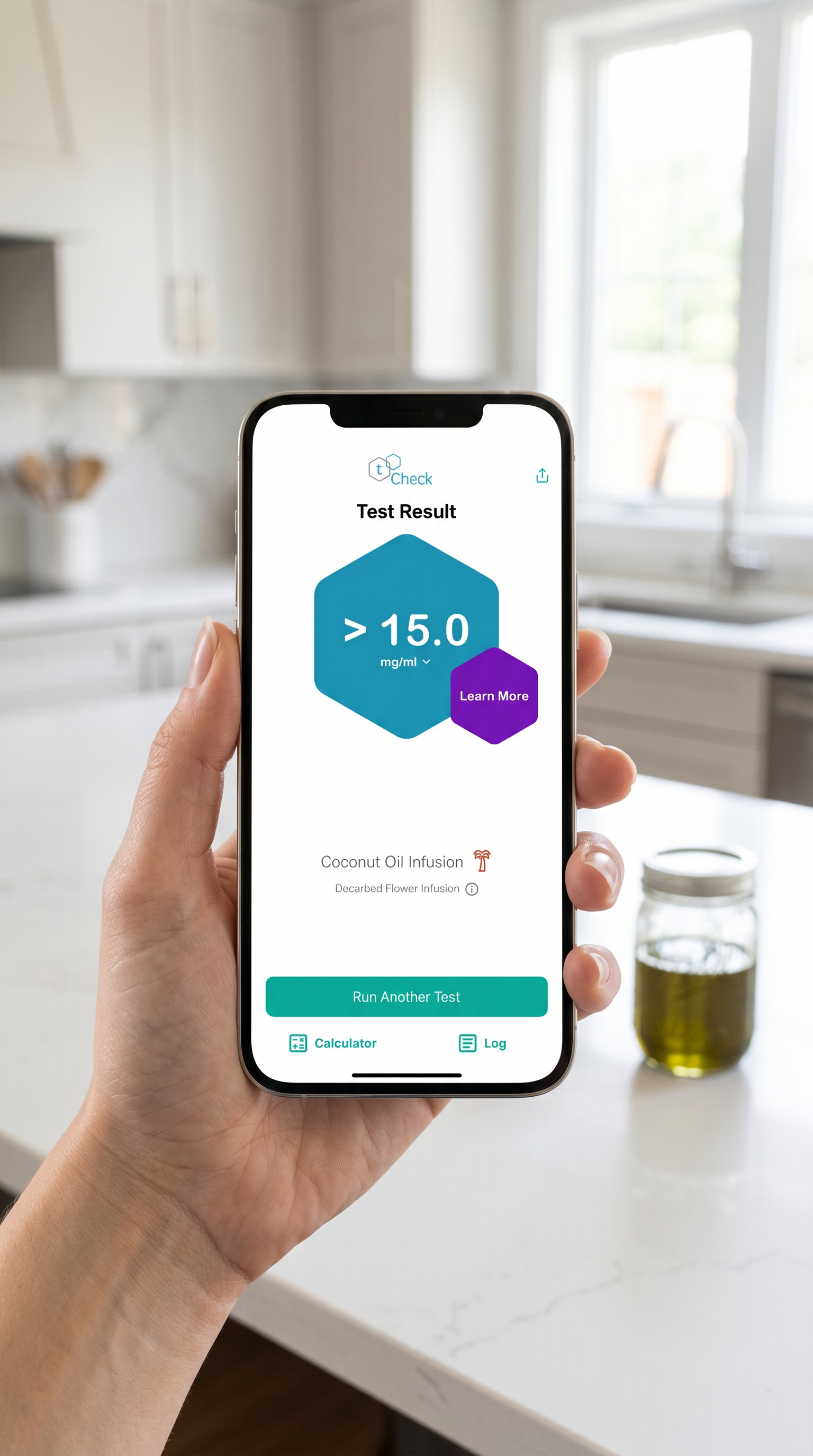
- Load the filtered sample into the tCheck device and run the test. From here, the process is identical to testing an infused oil. The device measures UV absorbance, applies the calibration curve, and the app displays your result in about 2 minutes.
- Read and record your result. The app displays your flower's potency and can help you calculate expected potency in a finished infusion based on your flower weight, oil volume, and assumed infusion efficiency.

🎯 What to Do with Your Flower Potency Result
Your flower test result gives you a starting-point potency — the concentration of cannabinoids in your raw material before any heat or infusion process. From there you can:
- Plan your infusion ratio. If you know your flower is 18% THCA and you're making cannabutter with 7 grams in 1 cup of butter, you can calculate a realistic expected potency range for your finished butter. Our guide on flower-to-oil ratios walks through the math.
- Compare strains. Testing multiple strains side by side before you commit to a large infusion helps you choose the best starting material for your intended potency target.
- Verify dispensary labels. Dispensary potency labels reflect the batch tested at the time of production, which may have been months ago. Testing at home tells you what's in the bag right now.
- Set realistic expectations. Infusion is never 100% efficient. Testing your flower first gives you the ceiling; testing your finished infusion afterward with the standard tCheck process tells you what you actually captured.

💡 Tips for Accurate Flower Test Results
- Grind finely and evenly. Uneven grind is one of the most common causes of lower-than-expected flower readings. Stems contain very little cannabinoid material — removing them before testing typically nudges your reading slightly higher.
- Measure everything precisely. Both your flower weight and your reagent volume need to be exact. Small errors compound into meaningful result differences.
- Don't rush the extraction. Give the reagent the full time the app specifies to pull cannabinoids from the plant material.
- Filter completely. A well-filtered, clear solution produces a much more accurate reading than a cloudy or particulate-heavy one. If your filtrate looks cloudy, filter it again.
- Test a representative sample. Just like with infused oil, the sample you test should be representative of your whole batch. Don't test just the densest part of a bud if you're planning to infuse the whole thing including trim and shake.
⚖️ Flower Testing vs. Infusion Testing — Do You Need Both?
The short answer: ideally, yes. They tell you different things.
Flower testing tells you what you started with. Infusion testing tells you what you ended up with. The gap between the two is your infusion efficiency — how much of the available THC actually made it into your oil or butter. Tracking both numbers over time helps you dial in your infusion process so you're consistently capturing as much potency as possible from your starting material.
If you can only do one, infusion testing is the more directly actionable number for dosing purposes. Knowing the mg/mL of THC in your finished oil is what lets you calculate per-serving doses accurately. But flower testing before you infuse is what lets you plan the infusion intelligently, choose the right material, and set realistic expectations for the batch before you've committed time and product to it.
Together, they give you complete visibility into your process from source to serving. That's a level of control that no recipe, calculator, or dispensary label can replicate — and it's what separates a confident, consistent home infuser from one who is perpetually surprised by their own batches.
✅ Ready to Start Testing Flower?
If you already have a tCheck device, the Flower Testing Expansion Kit is everything you need to unlock flower and concentrate testing. Each kit includes enough supplies for 20 tests, with refills available when you're ready for more.
If you're new to tCheck and want the complete setup from day one, the tCheck 3 — an at-home THC meter paired with the expansion kit gives you the ability to test flower, concentrates, infused oils, tinctures, and cannabutter — the full picture of your cannabis, from source material to finished edible.
Stop guessing what's in your flower. Test it, know it, and infuse with confidence.
📚 More Great Cannabis Blogs
❓ Frequently Asked Questions
Can I really test cannabis flower potency at home?
Yes. With the Flower Testing Expansion Kit, you can measure THCA potency in raw cannabis flower in minutes using the tCheck device and the included reagent. The process is straightforward once you've done it a few times. New to home testing? Our primer on the at-home potency tester covers what these devices actually do.
Does flower testing measure THC or THCA?
Raw flower contains THCA — the acidic precursor of THC. Until heat is applied, THC isn't yet active. The tCheck app reports flower readings in their THCA form so you know exactly what's in the bag before you decarb or infuse. For the chemistry behind the THCA-to-THC conversion, see our decarb primer.
How long does a flower test take with tCheck?
Sample preparation — grinding, weighing, mixing with reagent, and filtering — takes about 5 to 10 minutes. The tCheck device reading itself is about 2 minutes.
Do I need to decarb the flower before testing?
No. Flower testing measures THCA in the raw plant material; decarboxylation converts THCA to active THC, which happens during your cooking or infusion process. Testing before decarb gives you the cleanest read of what's in the flower itself. When you're ready to decarb, our guide to decarboxylating cannabis at home walks through four reliable methods.
How accurate is at-home flower testing with tCheck?
When you grind finely, measure precisely, and filter thoroughly, tCheck's flower readings are accurate enough for confident dosing planning. Treat your flower result as your starting-point ceiling, then test your finished infusion to see what you actually captured. For a deeper look at how tCheck compares to other potency testers, see our comparison page.
Know Your Flower Before You Infuse
The tCheck Potency Tester plus the Flower Testing Expansion Kit gives you lab-style THC readings on raw cannabis flower in about 2 minutes — so every infusion you make starts with a number, not a guess.
Get the tCheck Potency Tester →